Industrial Connectivity Solutions: Terminals
Cabur's offer can satisfy all installation needs, since its catalog includes terminals with different types of tightening and feed-through terminals in various sections.
In addition, it is approved by various international certification bodies, which allows its use with complete confidence and guarantees its reliability in the environments
industrial, even under extreme conditions of use.
Terminals with Push-in technology
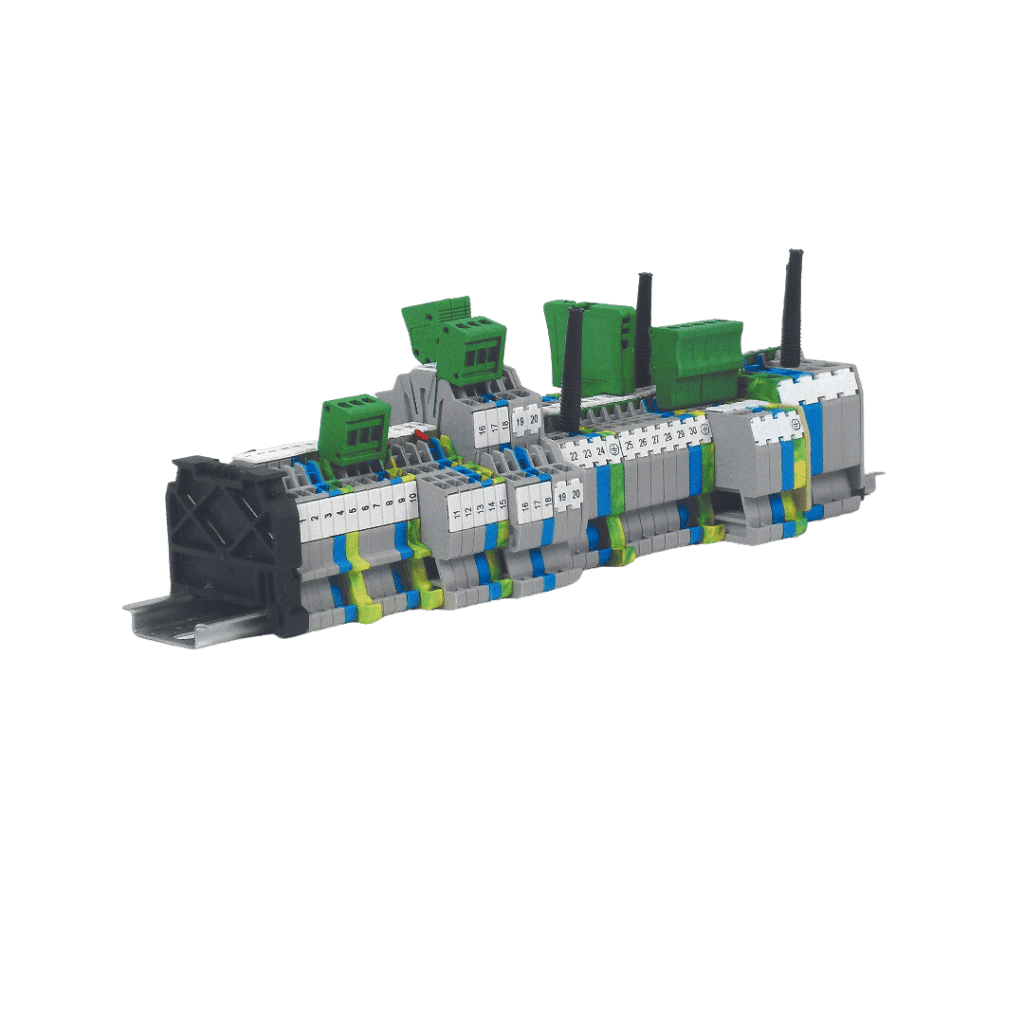
The new EFC product line with push-in connection technology offers fast, reliable, and efficient wiring of all types of cables.
Reduced installation time, increased performance
Push-in technology allows wiring of cables and hoses
Cables and hoses with or without clamps. The cables are inserted directly into the terminal, without the need for tools to open the clamp spring.
Direct plug-in
The connection is so simple, precise, and accurate that an electrical panel can be wired with one hand without compromising performance. This also improves ergonomics.
Cable release buttons: quick, easy, and safe To remove the cable from the terminal, simply press the release button with any tool to open the spring. The color-coded release buttons prevent operator errors.
Push-in Features
Speed Push-in technology helps reduce wiring times by up to 75%.
Security An insulated button, identified by a different color, protects the operator from indirect electrical contact.
Quality Having passed all tests for ATEX, UL and EN60947-7 directives, these devices are suitable for any use and environment.
Simplicity The stainless steel spring designed by Cabur guarantees an optimal connection and prevents accidental removal.
Innovation A compact and highly visible design optimizes space in automation and control panels.
Effectiveness Finally, one-handed wiring of an EFC series clamp is all it takes, for a smoother workflow.
Spring connection terminals
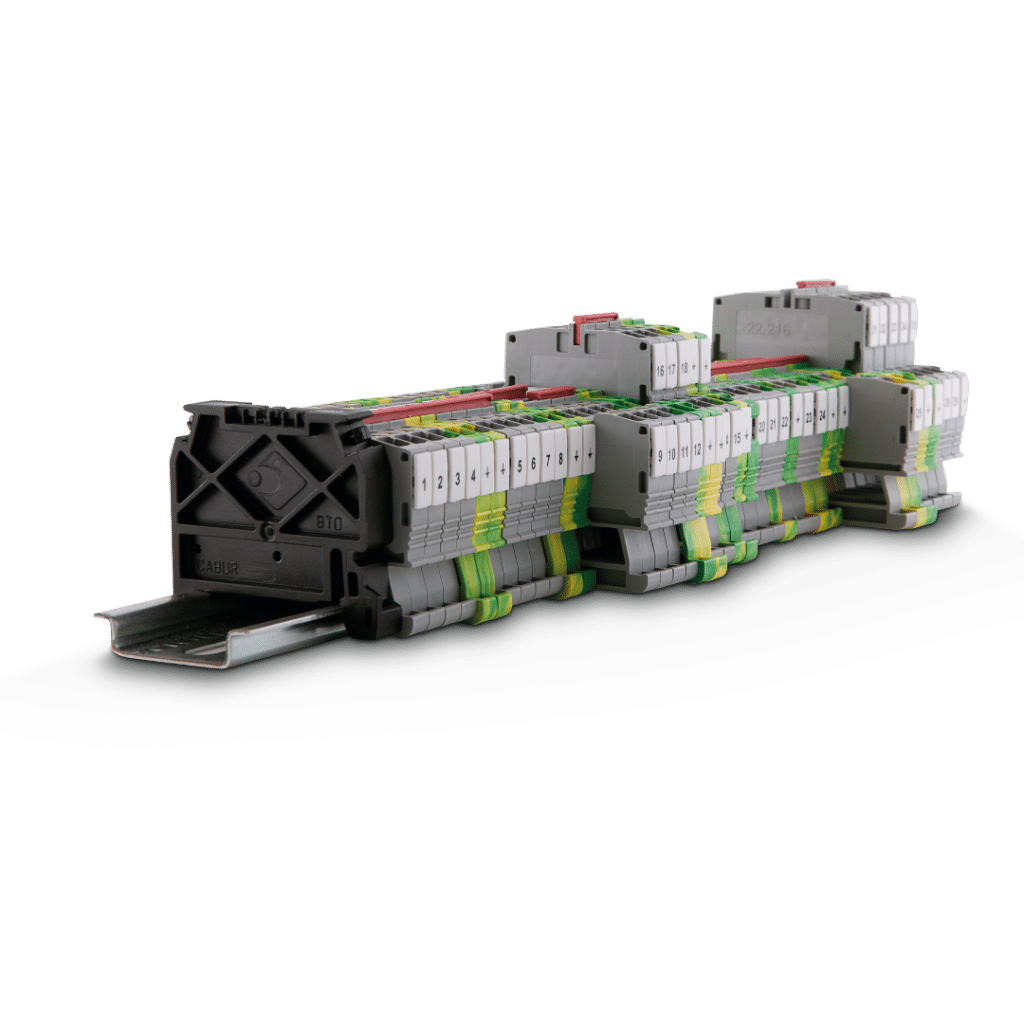
For the production of large volumes of bundles, for conductors from 0.2 to 25 mm2 and low current values, CABUR offers its range of spring-loaded terminals.
To protect the clamping system, the insulating body includes a stop that prevents the spring from exceeding the threshold of its elastic field if actuated by inexperienced hands.
The appropriate sizing of the wire insertion chamber, which meets the requirements of IEC 60947-1, guarantees the insertion of any type of conductor of the nominal size, even when butted against a terminal.
The resulting connection, in relation to the technology adopted, presents maximum reliability and safety thanks to the quality of the materials used and the particular conformation of the components necessary for this purpose.
Terminal blocks with nominal cross-sections ranging from 1.5 to 16 mm2 can be connected to each other in a wide variety of ways thanks to our exclusive "Easy Bridge" (PTC) quick connection system, which combines efficiency, speed, and flexibility while providing exceptional cost-effective results. These features, combined with the resulting IPXXB intrinsic installation without the aid of other insulation protections, guarantee better connectivity than that offered by competitors.
Spring Terminal Marking Systems
In our marking system, the same multiple numbering strip (SHZ) can be inserted into the sides of the strip or into the specific seats present on the top of the strip itself.
This means each terminal block is easily identifiable from any viewing angle within the electrical panel. Numbering can also be done using standard CNU/8 labels.
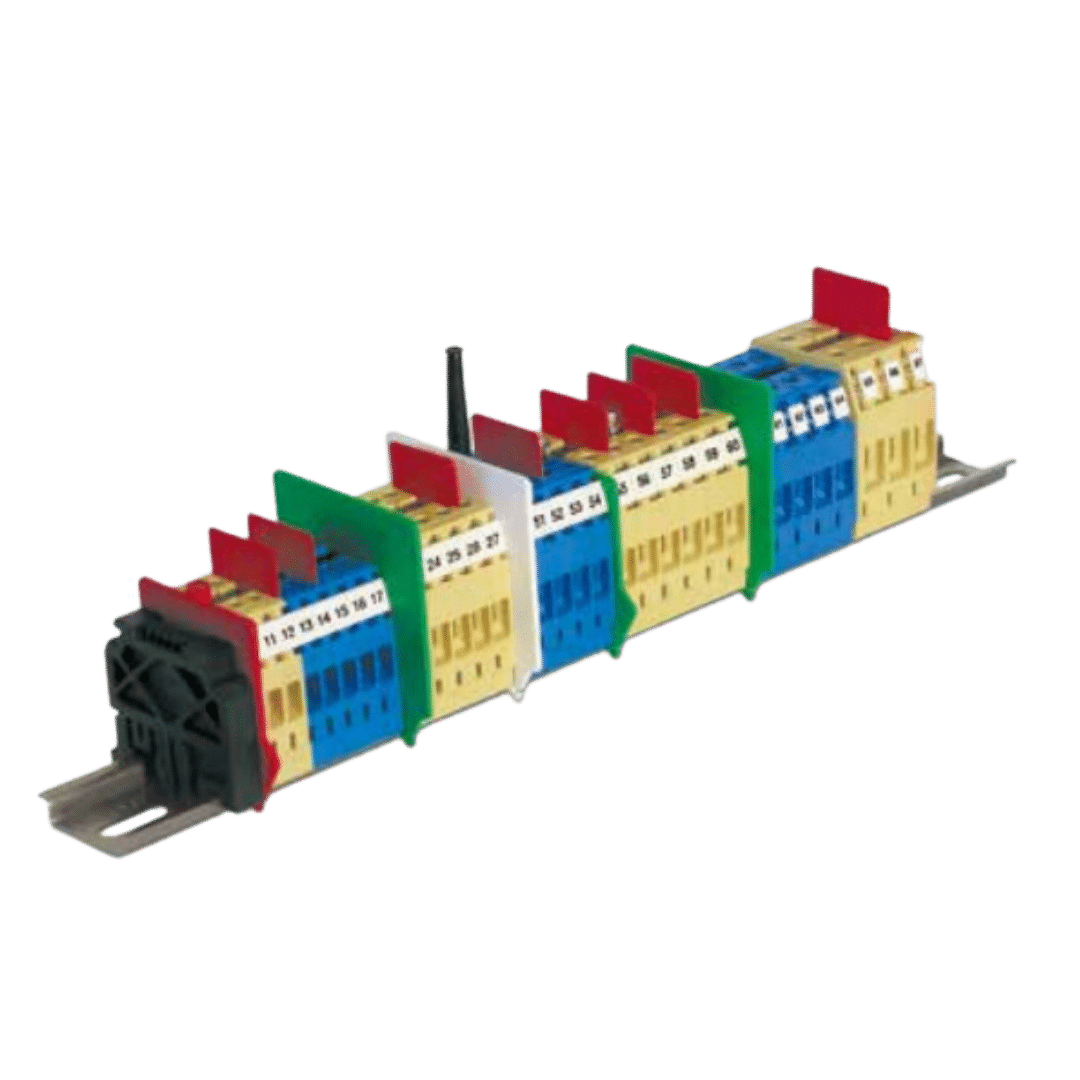
Screw connection terminals
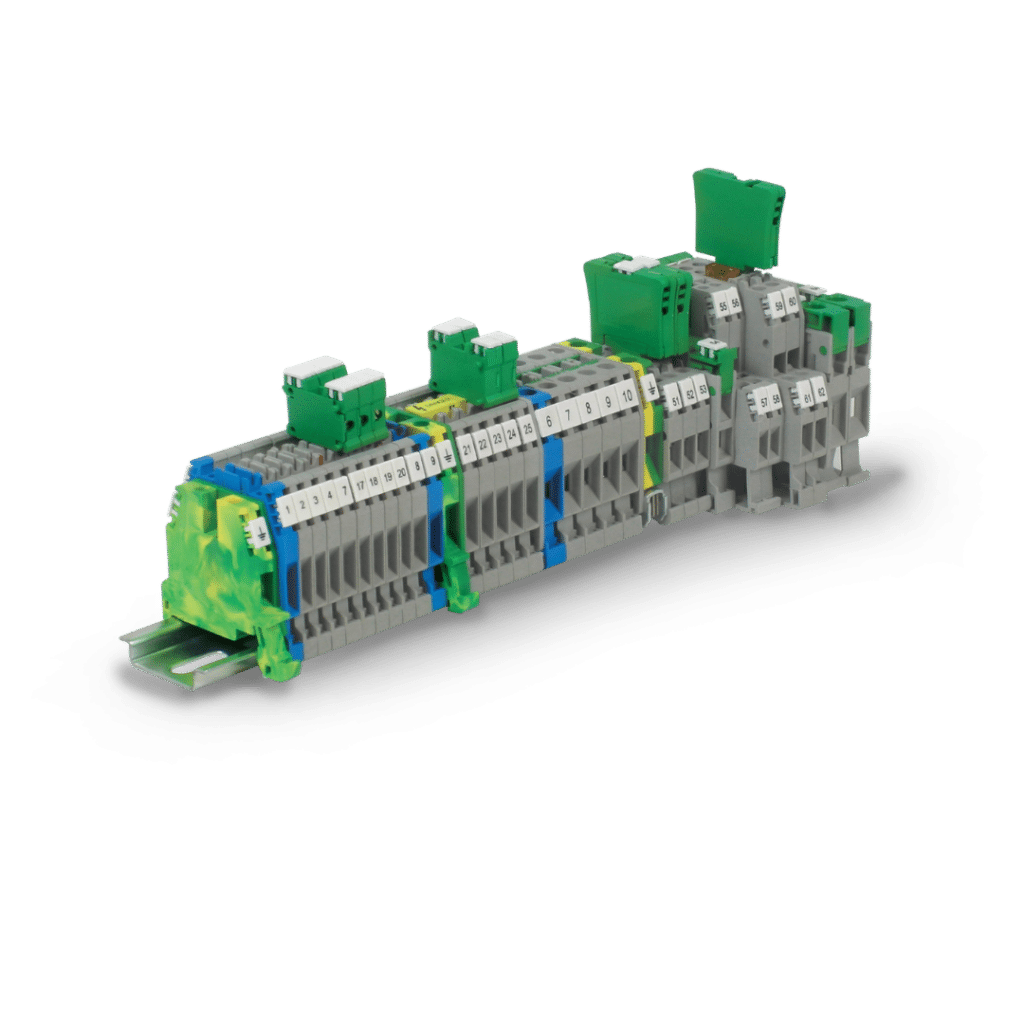
CBC Series
- Reduced overall dimensions
- Mounting on PR/3 rails according to IEC 60715, type TH/35 – Nominal voltage 1000 V – Maximum continuous operating temperature 130°C
- Double possibility of inserting multi-pole PTC cross-connects, without the need for additional insulating covers, thanks to the patented "Easy Bridge" (PTC) system and the new "Easy Bridge Plus" (PTP).
- Available in grey and blue; for other colours, see individual versions. Easy Bridge System
CBD Series
- Flame behavior UL94V-0
- Universal mounting on PR/DIN and PR/3 rails according to IEC 60715 standard
- Maximum continuous operating temperature 130°C
The CBD series comprises eight sizes, which are distinguished by: - Very small space occupation
- Great connection capacity
- Effective current capacity greater than the established reference values established reference values
- Very low contact resistance of the connection
- Materials of excellent quality and, consequently, maximum reliability over time
- Great practicality of use
Cabur has always designated each product primarily with a Code, distinguished by a letter part (usually 3) and a number, with a dot in between.
This number defines the nominal cross-section of the terminal in question; which, according to the reference standard, is "the figure, expressed in mm2, corresponding to the cross-section of the connectable conductor, declared by the manufacturer, to which the product's thermal, mechanical, and electrical parameters refer."
The field of use of the terminal block is, however, much broader and is defined by its connection capacity, that is, by the range of conductor cross-sections, both rigid and flexible, minimum and maximum, that the terminal block is capable of connecting, in full compliance with all the parameters established in the reference Standards.
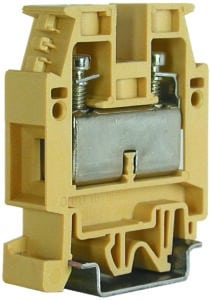
Features CBD Series
Connection type:
It is screw-type, indirect, and self-locking on both sides. The clamping screws are only accessible with a special screwdriver, and the unique shape of the head makes them impossible to lose. Screw-type clamping offers the best guarantees of mechanical tightness and efficient current flow and is suitable for connecting, with or without special preparation, conductors of all cross-sections. Tightening and loosening operations are extremely simple and are performed with commonly used tools, specifically screwdrivers; however, it is important, in all cases, to use screwdrivers of the appropriate characteristics and dimensions to avoid damaging either the screw itself or the insulating base.
Conductive body:
Sleeve-type, made entirely of copper-zinc alloy with nickel plating; the characteristics of the material used and the manufacturing methods are such that they prevent the phenomenon of possible breakage, known as "parking cracks."
Tightening reliability:
Appropriate orthogonal ribs, on the lower part of the sleeve and on the lower surface of the clamping plates, ensure perfect electrical contact with the conductors and effective mechanical locking in various situations. The conductor grip is particularly effective thanks to the elastic function of the clamping plate; it, in particular, tends to bend under the pressure of the screw, thus exerting a reaction on the screw head itself, which opposes unscrewing, even in the presence of dynamic stresses (vibrations).
Ease of insertion:
Inserting the conductor into the terminal block is made easier
- due to the inclined invitation surfaces made in the insulating base
- due to the rounded shape of the holding plate
by the appropriate size of the insertion hole relative to the maximum insertable conductor diameter. The conductor insertion depth is limited by a barrier placed on the insulating base.
Other functions
In addition to their primary function as feed-through terminals, CBD terminals are designed and manufactured to perform other functions. A hole in the top of the conductor body allows for a fixed or switchable cross-connection (cross-connection) between two adjacent terminals, a multiple common bar connection between several adjacent terminal blocks, and a test plug socket. A modular test plug socket for testing multiple signals can be used.
Marked: All CBD terminal blocks offer the possibility of coding on both sides using CNU/8, CNU/10 or CSC marking labels (the latter system allows the composition of alphanumeric codes of up to a maximum of four characters, six with the ADR/6 adapter).
Mounting: The CBD Series polyamide terminals are prepared to be mounted either on G32 or TH/35 type support rails (IEC 60715 standard), with obvious advantages and ease in the acquisition, management and, in general, use of the product.